
The Best Manifestation Apps in 2026, Compared Honestly
The best manifestation apps in 2026 are Vera if you want manifesting to replace doomscrolling, Stella or Mimi for personalised audio stories, Aya for affirmations in a dream-self voice, The Manifest App for Roxie Nafousi's seven-step method, and 369 Manifestation: Journal if you want a free manifestation app. Most are subscriptions, so try the free part before you pay.
Updated · by the Vera team
The best manifestation apps at a glance
The best manifestation apps in 2026 fall into three groups: AI apps that write personal stories or affirmations for you (Vera, Stella, Aya, Mimi, Soul), method apps that teach a specific practice (The Manifest App, Endly), and simple journals for the 369 method and scripting. We checked every app below on the US App Store on October 20, 2026. Prices change often and many apps test several at once, so treat the numbers here as a snapshot.
| App | Best for | Price model | Platform |
|---|---|---|---|
| Vera | Manifesting instead of doomscrolling | First letter free, then subscription | iPhone |
| Stella | Personalised dream-life audio stories | Subscription | iPhone, Android |
| Aya | Affirmations in a dream-self voice, morning rituals | Subscription plus paid extras | iPhone, iPad, Android |
| The Manifest App | Roxie Nafousi’s seven-step method | Subscription | iPhone, iPad, Android |
| Manifest - Endly | Neville Goddard style scripting and “I am” lines | Freemium | iPhone, Android |
| Soul | Quick personalised affirmations and visualisations | Freemium | iPhone |
| Mimi | Editable AI audio stories for sleep | Subscription | iPhone, iPad |
| 369 Manifestation: Journal | A free 369 method practice | Free core, optional Pro | iPhone |
1. Vera: manifest in the moment you reach for your phone
Vera is our app, so weigh this pick accordingly. It is built for one specific problem: you want to manifest every day, but the minutes go to TikTok and Instagram instead.
You choose the apps that steal your evenings and Vera seals them with Apple’s Screen Time. When you reach for one, you get a 20-second moment instead of a block screen: one tap for how you feel, then a short letter from your future self. Tap “open my apps” and they open for 10 minutes, then seal again. An emergency unlock is always there.
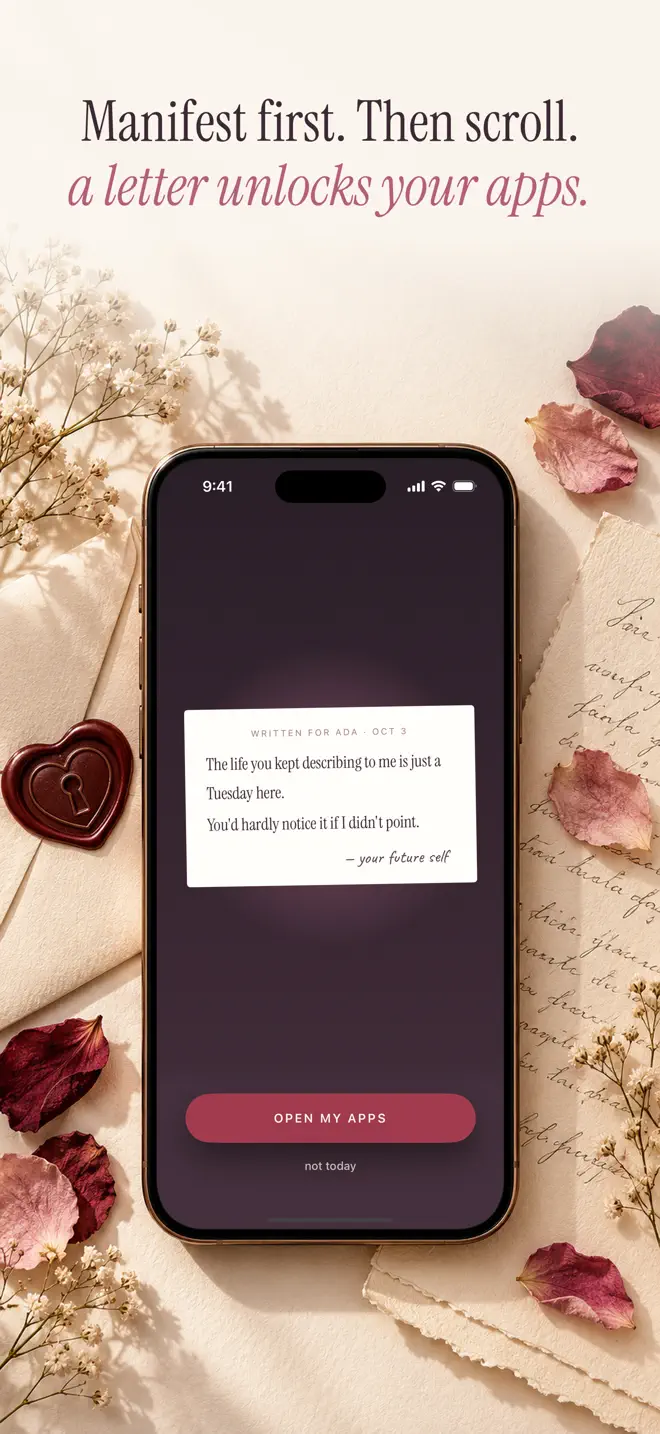
The letters are written from your own words: your name, the city you want to wake up in, what you want most. They are never repeated. There is also a new personal manifestation story every day, about three minutes long, read aloud in a warm voice, plus a vision board made from your own photos, affirmations, gratitude and a day streak.
- Best for: people whose manifesting habit keeps losing to the scroll.
- Privacy: Vera never sees which apps you use, your photos stay on your phone, and your answers are used only to write your letters, never sold or used to train a model.
- Downsides: it is iPhone only, with no Android version. Your first letter is free, but after that the letters, daily stories, vision board and the app seal are part of the Vera Plus subscription (yearly with a free trial for new subscribers, or weekly). It also needs Screen Time permission to work, which some people would rather not grant.
2. Stella: personal audio stories of your dream life
Stella - Manifest Anything, from Perl Productions, turns the goals you tell it into personalised audio stories that place you inside the life you want, plus affirmations generated for those goals. It works offline and tracks your progress, and it suits people who would rather listen to a visualisation than write one.
- Best for: “living in the end” through listening rather than writing.
- Price model: subscription. The US listing showed several “Stella Unlimited” prices from $6.99 to $29.99 without saying which period each covers.
- Downside: the listing only says “some features require a paid subscription”, so you find out what is free inside the app. It is in English only and has no iPad version.
3. Aya: affirmations in your dream self’s voice
Aya: Manifest Your Dream Self, from Lit Apps, is built around what it calls the Aya Method: voice, vision and gratitude. Affirmations are spoken in the voice of your “dream self”, and there are morning and wind-down audio rituals, a vision board and daily gratitude.
- Best for: a guided morning and evening routine with audio.
- Price model: subscription. The US page listed $9.99 a week, $29.95 a month or $149.99 a year, plus one-off purchases such as single audios at $1.99 and playlists at $4.99.
- Downside: it is one of the more expensive manifestation apps here, and some audio is sold on top of the subscription.
4. The Manifest App: Roxie Nafousi’s seven steps
The Manifest App comes from Roxie Nafousi, author of the MANIFEST books, and is built on her seven-step method. It combines daily affirmations, a meditation and breathwork library, a gratitude log, a habit tracker, journal prompts and goal setting.
- Best for: readers of her books who want the method in daily form.
- Price model: subscription, listed at $10.99 a month or $99.99 a year.
- Downside: it launched in August 2026, so it is very new, and it is English only. If you don’t connect with her approach, there is little here that isn’t in a general wellness app.
5. Manifest - Endly: scripting and the Neville Goddard approach
Manifest - Endly, from Zionverse, mixes an “I am” affirmations library with guided scripting, the list method, a manifestation tracker and a “Chat with Teacher” feature inspired by Neville Goddard.
- Best for: people who manifest by writing, and Neville fans.
- Price model: freemium, with weekly, yearly and lifetime options (a lifetime plan was listed at $39.99).
- Downside: iPhone only on Apple devices, with no iPad or Mac version.
6. Soul: fast personalised affirmations
Manifest & Affirmations - Soul lets you type in what you want and returns personalised affirmations, short visualisations with music, daily reminders and widgets. It is light and quick, which suits a two-minute morning check-in.
- Best for: a simple daily affirmation habit built around your own desires.
- Price model: freemium, with Soul Premium listed from $4.99 a month or $19.99 to $29.99 a year.
- Downside: English only and no iPad version. Its description mentions “scientifically backed” methods without naming sources.
7. Mimi: editable AI stories for sleep
Manifest your dreams - Mimi writes personal audio stories with AI and, unusually, lets you edit the story before it is generated. You pick from three narrator voices, and there are sleep sessions with ambient sound, a journal and widgets.
- Best for: people who want control over the exact words of their visualisation.
- Price model: subscription, listed at $7.99 a week or $79.99 a year, each with a three-day trial.
- Downside: the listing says a subscription is required to create new audio, and the app only launched in July 2026.
8. 369 Manifestation: Journal, the free option
369 Manifestation: Journal, from Tejas Rane, does one thing: it helps you write a single desire three, six and nine times a day. It adds scripting, a weekly insight report and an app lock, and it doesn’t ask for an account.
- Best for: a free manifestation app for the 369 method.
- Price model: core journaling is free; Pro was listed at $19.99 a year or $29.99 lifetime.
- Downside: the full weekly report is Pro only, and there is no audio, AI or vision board.
How to choose a manifestation app
Choose a manifestation app by matching it to the way you already manifest, not by feature count. Four quick tests:
- You listen more than you write. Pick an audio app: Stella, Mimi or Aya. Play a story the first night before the trial ends and notice whether you’d miss it.
- You like a method with steps. The Manifest App or Endly give you a structure to follow, and Endly’s scripting suits people who journal.
- You want to start for free. 369 Manifestation: Journal or Soul’s free tier. You can also write your first lines with our manifestation generator or a letter to your future self, no app needed.
- Your phone is the problem. If you open TikTok fifty times a day and your manifestation app twice, put the practice where your thumb already goes. That is what Vera does.
Before you subscribe, check three things on any manifestation app: what happens when the free trial ends, whether you can delete your data yourself, and whether the personal details you type in are used to train AI models.
Downsides worth knowing across the category
The biggest shared downside of manifestation apps is price: almost every AI-powered one is a subscription, and several use weekly billing, which adds up fast. Set a reminder for the day before any trial ends.
The second is that apps can make manifesting passive. Listening to a story is lovely, but most methods also ask you to act as the person you’re becoming. Use the app as a daily reminder, then do one small thing that person would do.
Finally, several of these apps are very new (The Manifest App and Mimi both launched in summer 2026), so expect changes to features and pricing, and judge them on what they do today rather than on promises.
Questions
What is the best manifestation app?
It depends on how you manifest. For personalised audio stories, Stella and Mimi are the closest fit; for a structured method, The Manifest App or Endly; if your real problem is that scrolling eats the time you meant to spend on your practice, Vera puts the practice in front of the apps you reach for.
Is there a free manifestation app?
369 Manifestation: Journal keeps its core journaling free, and Soul has a free tier with a paid upgrade. Most AI story apps, including Stella, Aya and Mimi, need a subscription for their main feature.
Do manifestation apps actually work?
No app can make something happen for you. What a good manifestation app does is keep your desire in front of you every day, in your own words, which is the part most people drop after a week.
Are manifestation apps safe for my private goals?
Read each privacy policy before you type in names or money goals. Look for clear statements on whether your answers are sold or used to train AI models, and whether you can delete your data yourself.